Goal and deadline
Name the outcome and timing without asking ChatGPT to promise a result.
Give ChatGPT a real training brief. Require exact exercises, effort, rest, and progression. Then treat the answer as a draft: check it, track what you complete, and use that history before changing next week.
GuideWrite the brief, check the plan, then improve it from what you completed.
General educational guidance. A generated plan cannot diagnose an injury or replace individualized professional advice.
Three days, 45 minutes, commercial gym. I’ll keep the main lifts stable, define progression, and show the plan before saving it.
Give ChatGPT the constraints that shape the plan.
Confirm effort, time, volume, and progression.
Log the sets and exercises you actually complete.
Change the future plan from evidence, not memory.
ChatGPT is useful at arranging explicit constraints into a draft. Vague requests produce plans that look complete while quietly guessing about your time, equipment, and experience.
Name the outcome and timing without asking ChatGPT to promise a result.
Include training age, consistency, and recent working sets when known.
Give honest days and session length so the plan can actually fit.
List the gym or home equipment the workouts may use.
Say which movements or training styles you enjoy, dislike, or want replaced.
Include relevant professional instructions and movements you have been told to avoid.
Replace the brackets, copy the prompt, and review the result before training. The interactive builder creates a more tailored version when you want one.
Act as a careful workout-planning assistant. Build a practical plan from the information below. Treat the result as a draft I will review, not medical advice.

My goal: [goal]
Training experience: [beginner / intermediate / advanced]
Days available: [days per week and preferred days]
Session length: [minutes]
Equipment: [home / commercial gym / available equipment]
Current baseline: [recent working sets or relevant capacity, if known]
Preferences: [exercises or training styles I enjoy]
Constraints: [movements to avoid, professional instructions, or other limits]

Ask no more than two essential clarification questions. Then provide:
1. A weekly schedule.
2. One table per workout with exercise order, sets, reps or time, effort target, and rest.
3. Useful substitutions that preserve the purpose of each exercise.
4. A warm-up that fits the session time.
5. A clear week-to-week progression rule, including when not to progress.
6. A rule for a missed workout, an unusually easy week, and an unusually hard week.

Keep every session within my stated time and available equipment. Use plain language and minimal filler. Do not tell me to push through sharp or worsening pain or override advice from a qualified professional.
A polished answer can still be unusable in a real gym on a real Tuesday. Read the plan once against these six questions before your first session, and again whenever the assistant rewrites it.
Do the training days land on days you are actually free, and does each session finish inside the time you gave?
Count the working sets and rest periods. A plan that needs 70 minutes on a 45-minute day will be abandoned in week two, not fixed in week two.
Does each session start with the work that needs you fresh, and end with the work that does not?
Heavier compound or skill-dependent movements usually belong before smaller isolation and finisher work.
Can you actually get from one exercise to the next in your gym, at your usual hour?
Watch for plans that hop between a squat rack, a cable station, and a bench repeatedly, or that assume a machine you do not have.
Are rest periods stated, and is there at least a day between sessions that hammer the same muscles hard?
Rest between sets should match the intent: longer for heavy strength work, shorter for accessory and conditioning work.
Across the week, do you push, pull, hinge, squat, and train your midsection?
Generated plans skew toward the movements people name in the prompt. Check what quietly went missing rather than what is listed twice.
For every exercise, do you know what to do instead if the equipment is taken or the movement hurts?
A substitution has to preserve the purpose of the exercise, not just the body part or the name.
ChatGPT can help with both a manual workflow and a connected one. The difference is whether your workout history is copied into chat or requested as structured, authorized data.
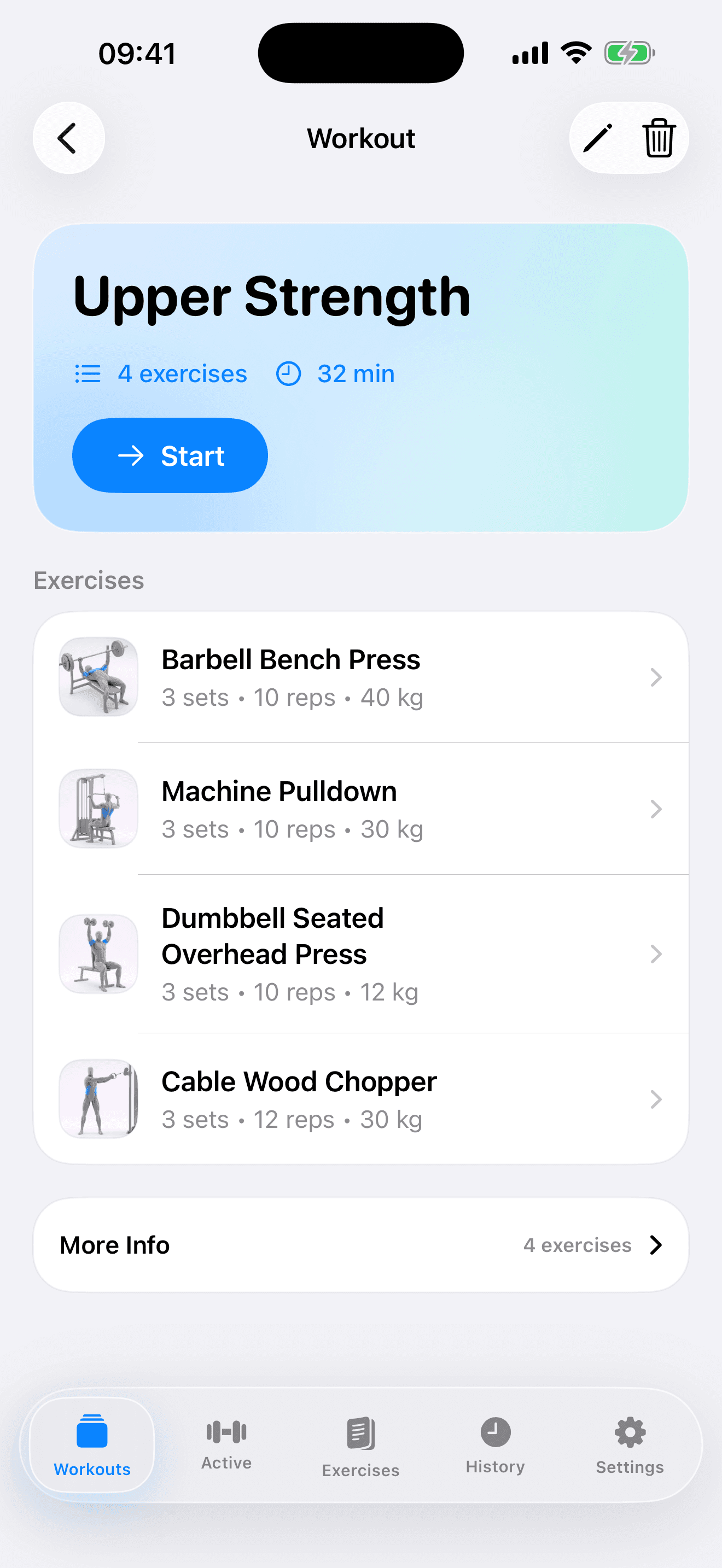
Authorize the Simple Muscle connection, ask ChatGPT to read your plans and completed sessions, then review any proposed future change before it is saved.
See the ChatGPT setup guideA difficult session is information, not automatically a reason to replace the program. Review a meaningful window, separate patterns from noise, and change future work only after the evidence is visible.
Review my last four weeks of completed workouts. Summarize consistency, weekly volume, and exercises where performance changed. State what the data cannot tell you. Do not edit anything yet.
For each main lift, compare the prescribed work with what I completed. Recommend the smallest justified change for next week, explain the evidence, and wait for my approval before saving it.
I can train only twice next week. Preserve the most important work from my current plan, keep both sessions within 60 minutes, and show the proposed change before saving it.
Most failures are not dramatic. The answer simply guesses, omits a prescription detail, or changes too much from too little evidence.
Asking only for “a good workout plan.”
Leaving out schedule, equipment, experience, or constraints.
Getting exercises and sets but no effort target or progression rule.
Accepting invented exercise names or impossible equipment transitions.
Rebuilding the whole plan after one unusually hard session.
Treating a chat transcript as a durable workout log.
Sharing more sensitive health information than the task needs.
A 2024 study of older ChatGPT versions found that most generated exercise recommendations were broadly accurate, but that important prescription details were often missing: how often to train, how hard, for how long, what type of work, how much of it, and when to progress. That supports a narrow conclusion: use the model to draft and explain, then check the plan yourself. It does not prove that current models are complete or that generated plans improve health outcomes.
Short answers to the decisions that matter before you generate, follow, or change a plan.
Start manually with the prompt builder, or connect ChatGPT to Simple Muscle so it can request the structured history you authorize.